04 Solution Architecture
After going back and forth on how this application will work, a solution has landed and been developed. This current solution is now live and honestly I do not mind having it described in the same place it is defending. I think it's fun! If ways around the solution are found, it is a learning experience for me.
Let's go through the biggest architectural decisions.
The Cascade
Cascading Bot Filters (from now on referenced to as CBF) had a main attraction in my brain, the Bloom Filters. But from the first time I wrote about this, the full solution was never too clear. After all this work, I will explain our current Bloom Cascade in CBF.
Bloom Filters in CBF are built every time there is a new item. This is important for the Banned IP Bloom which changes as Bans are either created or lifted based on its expiration time. When we build a new Bloom Filter, we look at the desired False Positive rate (let's say 1%) and provide the expected # of items in the Bloom. Then the calculations explained in Blog #2 of this series get processed and we get our Bloom Filter created with k Hash functions [1].
Banned IP Bloom
This is where the big realization was. All my previous ideas had the Path Bloom first because it was the most business crucial. But the Ban Bloom is more of a pre-check to the Path Bloom. If an IP is truly banned, the app shouldn't bother filtering through the path in the first place.
If the IP making a request is not in the Bloom Filter, then we know it is a guarantee and we can filter the path at O(k + L).
If the IP might be banned, then we have no other choice than to play it safe. We have to ensure that it is a true banned IP and we check the Banned IP Map. At a 1% False Positive rate it is a bit annoying, especially given the fact that Map checks are O(1). But this is where the simplicity of Bloom Filters scales incredibly. Nowadays the ban list is around 15 IPs a day. This honestly is slower than just the O(1) Map lookup. But if one day it were to be thousands, this Map lookup will start becoming computationally expensive, while the Bloom Filter stays a rather light cache hit.
Path Bloom
The Real Bloom filter that pays off. It holds all the paths for my current application. This includes static ones, like apple-touch-icon.png, and dynamic ones, like the blog path you are currently on! The creation of this list is complex, so let's just assume it is a trustworthy variable for this.
If the Path is guaranteed not in the bloom, return a 404, add the IP and its infraction to the DB. A certain number of infractions will lead to the IP being banned.
If the Path might be in the bloom, let the user forward. Accepting the 1% False Positive rate here is okay. If a non-existent path gets an app 404 rather than a CBF 404, it's not the end of the world.
func (s *Server) Check(ctx context.Context, req *authv3.CheckRequest) (*authv3.CheckResponse, error) {
    http := req.GetAttributes().GetRequest().GetHttp()
    path := requestPath(http.GetPath())   // strips the query string
    ip, haveIP := s.clientIP(req)

    // 1. Banned IP? deny before the path is ever looked at.
    if haveIP && s.banList.IsBanned(ip) {
        return denyBannedIP(), nil         // 403, empty body
    }

    // 2. Known path? forward.
    if s.cache.Contains(path) {
        return allow(), nil
    }

    // 3. Unknown path: queue the miss (non-blocking) and deny.
    if haveIP {
        s.diagnoser.RecordMiss(ip, path)   // async — nothing waits on the DB
    }
    return s.denyUnknownPath(), nil         // 404 + HTML page
}
Query Strings Are Free
Let's talk about the third line in the previous code block. It is a big consideration when building this app, URLs can carry user variables as well. I currently do not do that at all, but blog reference links is a consideration I have made before. I don't want to add limitations to my app due to CBF.
To avoid false-positive 404s and bans, query strings within a path are stripped from any incoming request path. Therefore only stripped paths are ever evaluated in the filter.
// requestPath returns the path with any query string removed. Envoy sends the
// full request target, so "/search?q=x" has to become "/search" before it is
// compared against the paths the database knows about.
func requestPath(fullPath string) string {
    questionMark := strings.IndexByte(fullPath, '?')
    if questionMark >= 0 {
        return fullPath[:questionMark]
    }
    return fullPath
}
Distributed Solution & External PSQL Requirement
I had already mentioned that we would most likely need a point of truth for CBF to record its data. With internal K8s pod load balancing and keeping count of bans, we would have off-sync replicas with banned IPs that others don't know about. So some sort of point of truth is a must.
But why PSQL? Other than the fact that I love CNPG and spinning up DB clusters that manage themselves is AWESOME [2]. Given how quick and concurrent a scanner is, we must have a data storage system that is able to handle this concurrency. This means using something as simple as a PVC would lead to corrupted files and inconsistencies due to concurrency. DBs like PSQL also come with nice features like notifying on change and a query engine that's already laid out. As a DB solution, PSQL is the standard in this shop, so that is what was spun up to solve the concurrency problem.
DB Caching
This brings a separate problem which I had foreseen. Having to query the DB every time for the Ban list and Path list is incredibly wasteful! So we must cache them, at startup pull the tables from the DB and create the original Blooms.
Then using LISTEN & NOTIFY we watch these 2 tables for any changes [3],[4]. On change, the new list of paths or banned IPs gets pulled and the Bloom Filters rebuilt asynchronously on each replica. Each replica then swaps the bloom filter that is currently being used through an atomic pointer.
Regarding ban expiration, the CBF replicas themselves have a poll interval that will rebuild the Bloom Filter if required. This solution looks dumb and unoptimized, unlike having a timer for the next expiration. But it is in line with a defensive coding idea. If a NOTIFY were to be dropped, we still would be eventually consistent across all replicas.
With this solution we are able to have, in memory, the light Bloom Filters that decide which requests my application responds to.
func (c *Cache) run(ctx context.Context, changed <-chan struct{}, pollInterval time.Duration) {
    ticker := time.NewTicker(pollInterval)
    defer ticker.Stop()
    for {
        select {
        case <-changed:    // LISTEN/NOTIFY: a ban was written → rebuild now
            c.refresh(ctx)
        case <-ticker.C:   // poll: catches expiries, which fire no NOTIFY
            c.refresh(ctx)
        case <-ctx.Done():
            return
        }
    }
}
The Integration
External Authz
Here is a section that I have gone back and forth with a lot. At which proxy should this filter take effect? Given my work with Coraza and its Envoy Gateway API integration, it only seemed natural to have a Coraza WASM module for it. This turned out to be the biggest dead end of this project. Coraza's default rules do not have a way to make a gRPC callout [5]. Even looking at rebuilding a CBF Coraza library would turn out to be futile given:
- The WASM module shipped with Envoy is compiled in TinyGo. So it would have to be rebuilt from the ground up [6].
- It would become a CICD nightmare. Adding another tightly coupled dependency would almost certainly result in an endless onslaught of defects.
Okay, back to the whiteboard. I know I have one big constraint. I want Coraza rules to apply before CBF makes any sort of evaluation. So that shortens the amount of options heavily. We have two options:
- This blog itself queries CBF as a global middleware.
- We have Envoy Gateway use External Authz to get an evaluation [7]. After Coraza rules, of course.
Being the devil's advocate here. They are both good. It is an architectural preference and mine was to have Envoy query CBF before it even reaches the application. This way, we are defending the target before it is even reached. Having the application itself return the 404s and 403s has the added benefit of keeping the 404 HTML in-house. But I wanted to not tightly couple CBF with the future developement of this webpage, because of similar reasons I didn't create my own Proxy WASM solution to fit this app in.
To integrate this call out, we will have to apply some of the same principles as with OIDC in Envoy. We will need a SecurityPolicy in the same namespace as the app we are trying to defend. Then in the CBF namespace we will have a ReferenceGrant that lets this security policy make this callout [8]. The only new section I haven't already shown you is how we let our EnvoyProxy object know the filter order we must follow. This means that all routes in the proxy will have this ordering [9].
apiVersion: gateway.envoyproxy.io/v1alpha1
kind: EnvoyProxy
metadata:
  name: dataplane
spec:
  ...
  filterOrder:
    - name: envoy.filters.http.wasm
      before: envoy.filters.http.ext_authz
XFF Spoofing Protection
Last key detail with our path to production. My original plan was to rely on the X-Forwarded-For header to obtain the original IP of the request. This was very flawed because XFF is a header that proxies simply append to [10]. So it can easily be spoofed, a crawler can always add IPs at the very beginning of the XFF header and try to trick us into banning the wrong IP. I had already seen cases of IP spoofing in my telemetry. With ridiculous 8.8.8.8 or 1.2.3.4 as the first hop of the request.
To guarantee this application will only be looking at the origin of our request at our first hop. I ensured to record it as a separate header and CBF will trust that. The trust is built by having the first proxy rewrite that header with the incoming request's origin IP. Thankfully, AWS CloudFront, as my first proxy, makes this incredibly easy (and somehow doesn't cost a liver) [11].
Architectural Diagram
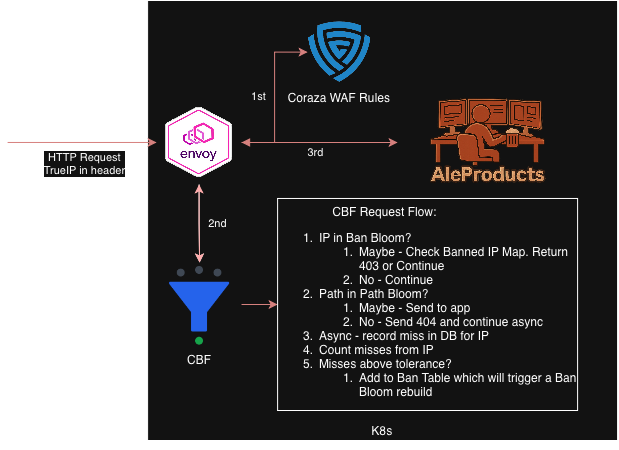
The lines are pink because the background is white and my girlfriend loves pink
Open Sourcing
Will open source once I get more production data on it.
References
- [1] Bloom Filter Double Hashing Harvard Paper
- [2] CNPG Documentation, Again
- [3] PSQL Notify Documentation
- [4] PSQL Listen Documentation
- [5] Coraza SecLang Operators
- [6] coraza-proxy-wasm Github Repo
- [7] Envoy Gateway Ext Auth
- [8] Gateway API Reference Grant
- [9] Envoy Gateway EnvoyProxy Filter Order
- [10] XFF Header Reference
- [11] AWS Cloudfront Headers